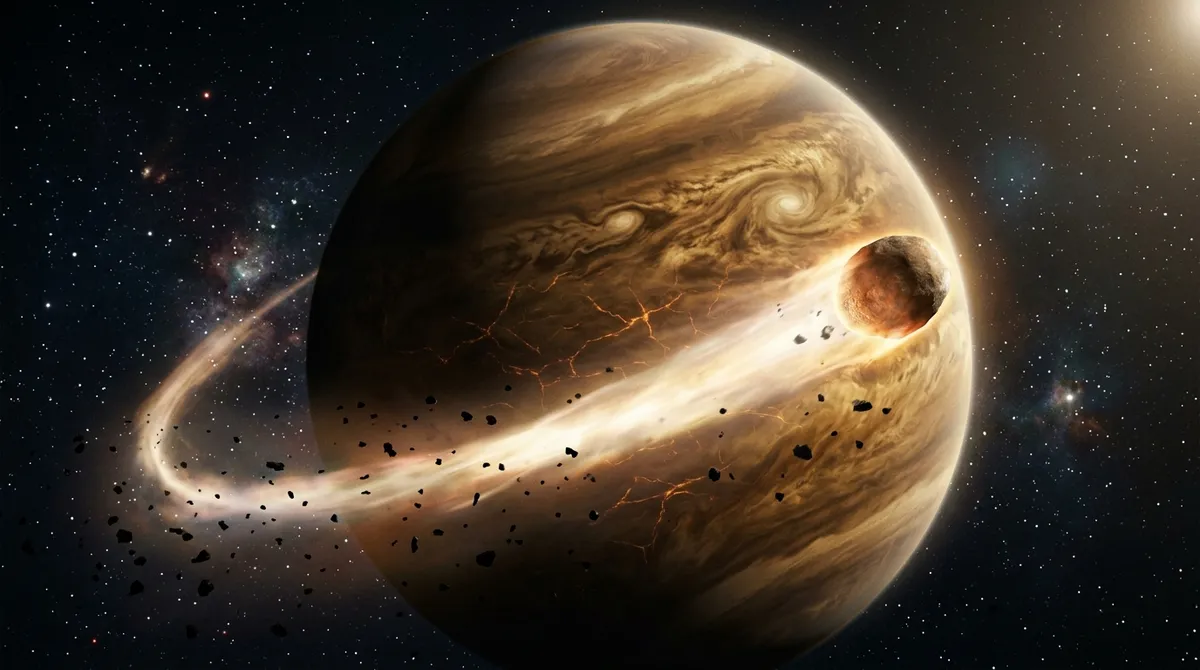
Venus has always been the odd one out in our solar system. While most planets spin in a predictable direction, Venus rotates backward — and agonizingly slowly at that. Now, a new scientific model is offering a dramatic explanation: a high-velocity collision with a moon-sized impactor may have fundamentally rewritten Venus' rotational story billions of years ago.
The Ancient Crash That May Have Changed Everything
According to the new model, Venus' unusual rotation wasn't always this way. Early in the solar system's history, a massive impactor — roughly the size of a moon — struck Venus at a high angle. The force of that collision is thought to have been powerful enough to dramatically alter the planet's spin, potentially reversing it entirely.
But the consequences didn't stop at rotation. According to reports, the impact may have also melted a significant portion of Venus' mantle, setting off a cascade of geological and atmospheric changes that would shape the planet's long-term evolution. In other words, one catastrophic moment may have redirected the entire fate of a world.
Why Venus Spins Backward
Earth rotates counterclockwise when viewed from above the North Pole — and so do most planets in our solar system. Venus, however, spins clockwise. This retrograde rotation has puzzled scientists for decades.
Previous theories proposed that gravitational interactions or atmospheric dynamics might have slowly reversed Venus' spin over geological timescales. But the new impact model offers a more dramatic and direct explanation: a single high-angle collision could have done the job in a geological instant, cosmically speaking.
If the model holds up, it reframes Venus not as a planet that drifted into weirdness, but one that was knocked into it — a victim of the violent, chaotic early solar system where massive impacts were far more common.
A Climate Destiny Shaped by Collision
The implications stretch well beyond rotation. Scientists studying Venus are increasingly focused on understanding how it transformed from what may have been a temperate world into the hellish, cloud-smothered greenhouse it is today. Surface temperatures on Venus are hot enough to melt lead, and its dense atmosphere is a suffocating blanket of carbon dioxide.
The connection between rotation and climate is more direct than it might seem. A planet's spin rate influences how heat is distributed across its surface, how its atmosphere circulates, and whether liquid water can persist. A slower spin, like Venus now has, means one side bakes under the sun for far longer stretches — a factor that could accelerate a runaway greenhouse effect.
If the ancient impact truly reshaped Venus' rotation, it may have also nudged the planet down a climatic path from which there was no return.
Could Venus Have Once Been Habitable?
This is perhaps the most profound question lurking beneath the impact model. Venus sits within the inner edge of the sun's habitable zone, and some researchers have speculated that early Venus — before whatever catastrophe transformed it — may have harbored liquid water and milder conditions.
Venus is often called Earth's twin. The two planets are remarkably similar in size, mass, and composition. Yet they couldn't be more different today. Understanding why requires untangling Venus' deep past, and the rotation history is a crucial thread in that story.
If a moon-sized impactor triggered the chain of events that doomed Venus, it raises an unsettling question: how close did Earth come to a similar fate? The early solar system was a shooting gallery, and Earth absorbed its share of massive impacts too — most famously the one thought to have formed the Moon.
Venus as a Warning for Planetary Science
Beyond its own history, Venus has become a kind of cautionary tale in the broader study of planetary habitability. As astronomers discover exoplanets in distant star systems, Venus-like worlds — rocky planets close to their stars with thick, toxic atmospheres — are turning up frequently.
Understanding how Venus became Venus matters for interpreting those distant worlds. Was it always destined to be hostile? Or did a single violent event seal its fate?
The new impact model doesn't answer every question, but it adds a compelling piece to the puzzle. It suggests that planetary destiny isn't always written gradually — sometimes it's decided in a single catastrophic moment, by the chance trajectory of a moon-sized rock hurtling through the early solar system.
As scientists continue to study Venus ahead of upcoming missions aimed at peering beneath its thick clouds, the story of that ancient collision may prove to be one of the most consequential in our solar system's history.