
The Discovery That Changes Everything
For decades, archaeologists studying the Langobards—a fierce medieval Germanic people—believed they had the violence patterns figured out. Every skeleton showing signs of interpersonal violence belonged to men. The narrative seemed clear: warfare and brutality were exclusively male domains in Langobard society.
Then came T46—a nearly 1,400-year-old skeleton that shattered this assumption entirely.
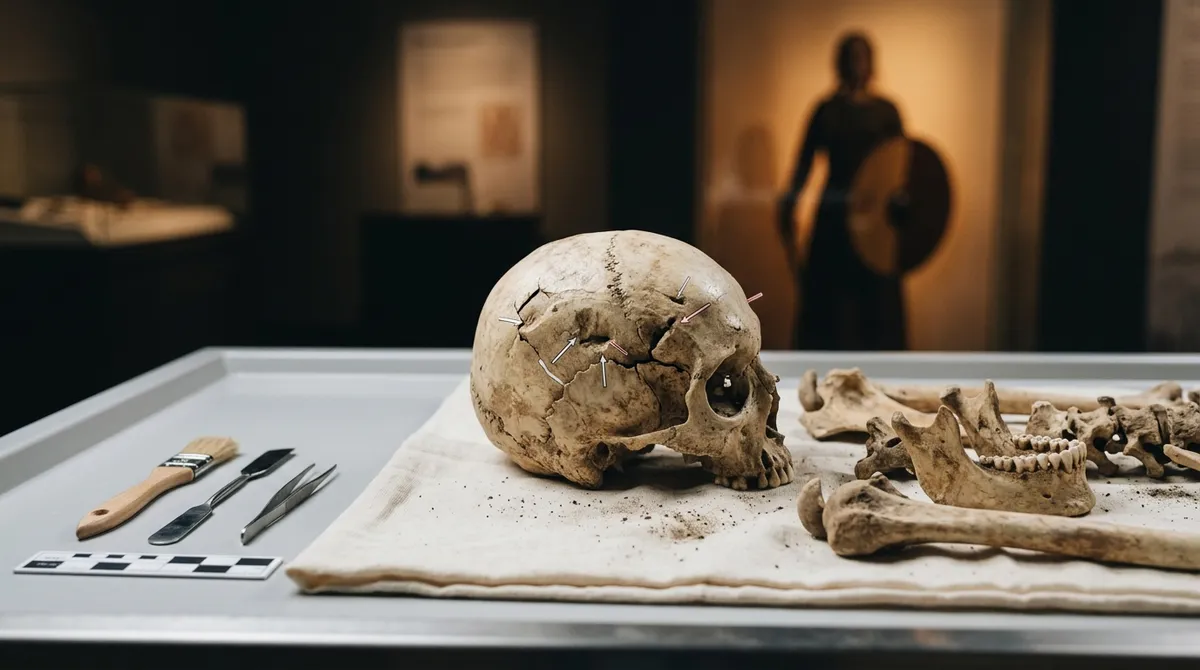
Archaeologists discovered the first skeletal evidence of interpersonal violence in a Langobard woman when they examined T46's remains. This ancient individual had survived not one, but two severe head wounds: a blade slash and a crushing blow. Her survival and the nature of her injuries fundamentally challenge how we understand gender roles and violence in early medieval societies.
When Bones Contradict the History Books
The irony of this discovery runs deep. While archaeological evidence had suggested that only Langobard men experienced violence, historical legal records from the same period tell a completely different story. These documents explicitly mention women engaging in and experiencing violence, creating a puzzling disconnect between what the law acknowledged and what the bones revealed.
This gap highlights a critical issue in how we interpret the past. According to reports, the absence of skeletal evidence had created false historical narratives, leading researchers to conclude that women were somehow protected from or uninvolved in the violent realities of their time.
The Hidden Nature of Women's Violence
The reason women's experiences of violence have remained largely invisible in the archaeological record comes down to the types of violence they faced and their roles in society. Unlike men who might die in armed raids or battlefield conflicts—leaving clear marks on bones—women's experiences of violence often involved household abuse that bruises soft tissue rather than skeleton.
Additionally, women were less likely to participate in armed raids where fatal injuries were more common, making their violent encounters less likely to leave the dramatic skeletal evidence that archaeologists typically find.
Scientific Detective Work Reveals the Truth
Identifying T46 as female required cutting-edge scientific methods. The skeleton's bones were too damaged for traditional sex determination techniques, so researchers turned to protein analysis to confirm T46's biological sex. This technological approach proved crucial in establishing that this was indeed a woman who had experienced significant violence.
The analysis revealed that T46 didn't just experience violence—she survived it. The healing patterns on her bones indicate she lived for years after sustaining these severe head wounds, suggesting her community provided care despite her traumatic injuries.
Implications for Historical Understanding
This discovery forces historians and archaeologists to reconsider fundamental assumptions about gender and conflict in ancient societies. The Langobards have long been depicted as fierce warrior-like people, but this characterization was based on incomplete evidence that inadvertently erased women's experiences.
T46's skeleton demonstrates how a single archaeological find can rewrite historical narratives that seemed established. It underscores the importance of questioning assumptions, especially when physical evidence appears to contradict contemporary written records.
Looking Forward: What This Discovery Opens Up
The identification of T46 opens new research possibilities for understanding women's roles in Langobard society and beyond. Future isotopic studies and ancient DNA analysis could potentially uncover more hidden cases of female violence that have been overlooked in existing collections.
This research direction could reveal whether T46 was an anomaly or whether women's experiences of violence were actually more common than previously believed. Each new discovery has the potential to further reshape our understanding of how gender, violence, and survival intersected in the medieval world.
The story of T46 serves as a powerful reminder that history is constantly being rewritten as new evidence emerges, and that our understanding of the past must remain flexible enough to accommodate discoveries that challenge long-held beliefs.