
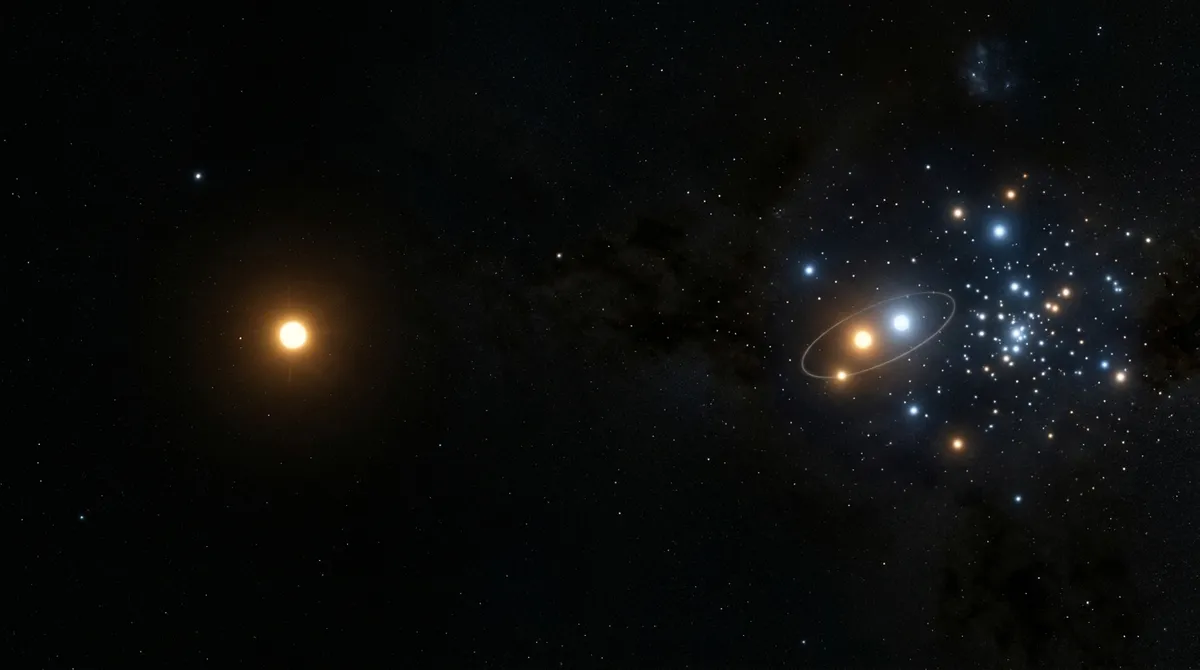
The Cosmic Neighborhood Census
Our sun's solitary existence through the cosmos turns out to be far more unusual than scientists previously understood. A groundbreaking new study published on arXiv has created what researchers call a near-complete census of multiple star systems within 10 parsecs of Earth, revealing that stellar companionship is the norm rather than the exception.
The comprehensive survey identified 424 stellar and sub-stellar objects organized into 92 bound multi-star systems within our cosmic neighborhood. According to the research, this detailed mapping represents one of the most complete catalogs of nearby stellar relationships ever assembled.
Why Massive Stars Travel in Packs
The study's most striking discovery centers on a clear pattern: higher-mass stars are far more likely to have stellar companions, while low-mass red and brown dwarfs typically exist as solitary objects. This finding suggests that stellar mass plays a crucial role in determining whether stars form as part of binary or multiple-star systems.
The research reveals that massive stars essentially "travel in packs," bound together by gravitational forces that can maintain their cosmic dance over millions of years. These stellar partnerships can involve complex orbital relationships, with some companion stars taking extraordinarily long periods to complete their gravitational circuits around each other.
Implications for Planet Hunting
This stellar census carries profound implications for humanity's search for Earth-like exoplanets. Next-generation space missions, including NASA's planned Habitable Worlds Observatory and the European Space Agency's LIFE mission, will require precise target lists to maximize their effectiveness.
According to the study, binary stars can significantly complicate the search for Earth-like planets. Hidden stellar companions can create observational challenges that waste precious telescope time and compromise the ability to detect potentially habitable worlds. The presence of a second star in a system can interfere with the delicate measurements needed to identify and characterize distant planets.
The Future of Exoplanet Discovery
The timing of this research proves particularly crucial as space agencies prepare for the next generation of planet-hunting missions. These upcoming observatories will need clean target lists that account for stellar multiplicity to avoid dedicating observation time to systems where companion stars might mask or complicate planet detection.
The census helps sharpen the search for nearby Earth-like planets by providing mission planners with a detailed map of which local stars are truly single, exist as binary pairs, or participate in more complex multiple-star arrangements. This information allows scientists to prioritize observations of systems most likely to yield clear, unambiguous detections of potentially habitable worlds.
Our Unusual Solar System
The research reinforces the growing understanding that our solar system's configuration may be more exceptional than previously thought. While our sun's lack of a stellar companion once seemed relatively normal, this comprehensive survey of our cosmic neighborhood suggests that solitary stars like our sun represent a minority population.
This revelation adds another layer to the ongoing discussion about what makes Earth and our solar system potentially unique. The absence of a binary companion may have played a crucial role in allowing stable planetary orbits and the long-term conditions necessary for life to develop and flourish on our planet.
Looking Beyond Our Neighborhood
As astronomers continue to map stellar relationships throughout the galaxy, this local census provides a foundation for understanding broader patterns of star formation and evolution. The research methodology and findings could inform larger-scale surveys that extend our knowledge of stellar multiplicity far beyond the 10-parsec boundary.
The study represents a significant step forward in our understanding of how stars form, evolve, and interact within their cosmic neighborhoods, while simultaneously providing practical guidance for the next phase of exoplanet exploration that could ultimately answer one of humanity's most profound questions: Are we alone in the universe?