Against All Odds: The Javan Leopard's Survival Story
In one of the world's most densely populated places, an extraordinary conservation drama is unfolding. Java, home to over 150 million people, harbors fewer than 350 individuals of one of Earth's rarest big cats—the Javan leopard. New research from the University of Twente is rewriting our understanding of how these magnificent predators survive in such an unlikely setting.
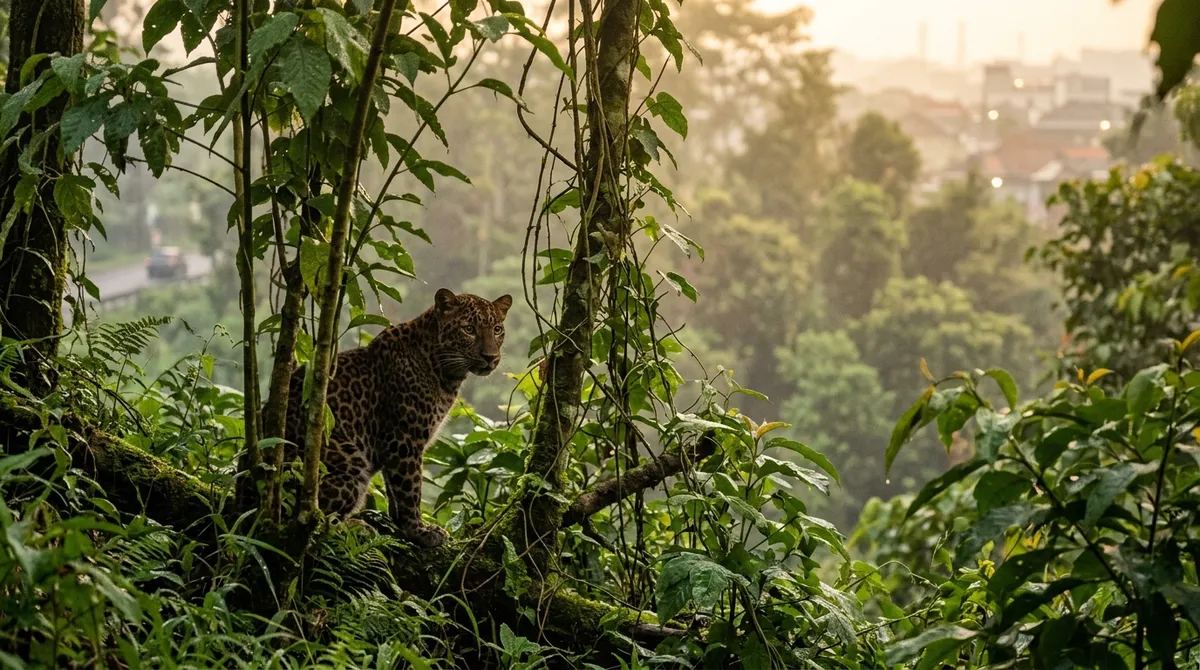
The study, utilizing camera traps and sophisticated spatial modeling, reveals a surprising truth: these leopards aren't just clinging to existence in protected reserves. Instead, they're thriving in regenerating secondary forests and utilizing corridors that connect fragmented habitats across the island.
The Power of Second-Rate Forests
Conventional conservation wisdom has long prioritized pristine wilderness areas, but the Javan leopard is challenging that assumption. According to the research, secondary forests—areas where vegetation has regrown after disturbance—are doing the "heavy lifting" in conservation efforts.
These regenerating landscapes provide the diverse prey base that Javan leopards depend on for survival. Rather than being relegated to small, isolated protected areas, the cats are adapting to a mosaic of habitats that includes these recovering forest patches. This adaptability has become their lifeline in a landscape increasingly dominated by human infrastructure.
Mapping the Path to Survival
The University of Twente research goes beyond documenting where leopards currently live—it provides a blueprint for their future survival. Using spatial data analysis, the study identifies exactly where habitat corridors, reforestation efforts, and conservation reserves could make the most significant impact.
This mapping approach reveals the critical importance of connectivity in fragmented landscapes. As roads, railways, and expanding cities continue to slice through Java's remaining forests, these corridors become literal lifelines for leopard populations that might otherwise become isolated and genetically bottlenecked.
Beyond Protected Boundaries
The findings highlight a crucial shift in conservation thinking: protected areas alone cannot save large predators in human-dominated landscapes. The Javan leopard's story demonstrates that conservation success increasingly depends on managing entire landscapes, not just fenced-off reserves.
This approach offers actionable guidance for urban planners and conservationists working in similar environments worldwide. By identifying where strategic interventions—whether reforestation projects, wildlife corridors, or habitat restoration—can have maximum impact, the research provides a data-driven roadmap for coexistence.
A Global Conservation Model
Java serves as a microcosm of wildlife challenges facing our increasingly crowded planet. As large carnivores vanish globally due to habitat loss and human pressure, the Javan leopard's resilience offers both hope and urgency.
The research reveals that even in one of Earth's most densely populated islands, creative conservation solutions can work. However, this success story remains fragile. The continued survival of these 350 leopards depends on immediate, strategic action to maintain and expand the habitat connections they rely on.
The Race Against Time
While the Javan leopard's adaptability is remarkable, time is running out. Every new road that cuts through habitat, every forest patch that falls to development, and every corridor that gets severed reduces the species' chances of long-term survival.
The University of Twente research provides the tools needed to make informed decisions about where conservation efforts will have the greatest impact. But tools are only as effective as their implementation—and that requires immediate action from policymakers, planners, and conservationists working across Java's complex landscape.
The story of Java's last 350 leopards is ultimately a story about coexistence. In a world where human and wildlife territories increasingly overlap, their survival depends not on keeping these magnificent cats locked away in reserves, but on creating a landscape where both species can thrive together.