
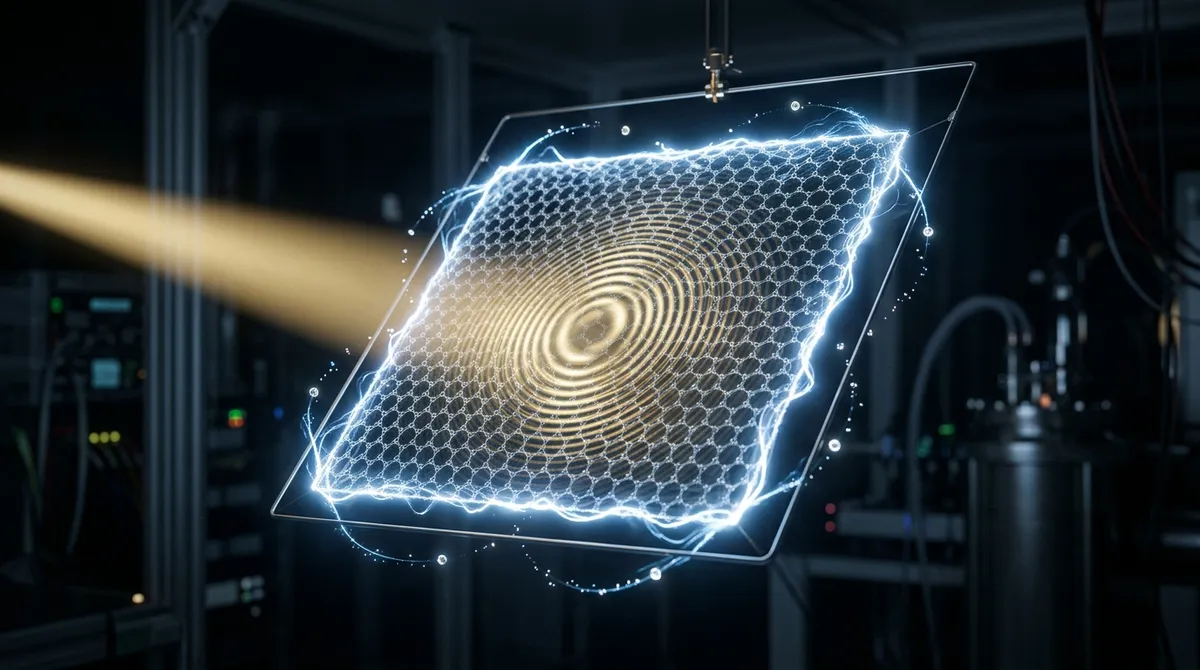
The exploration of fractional Chern insulators is opening new horizons in the world of quantum materials. Researchers are delving into these exotic states of matter, which exhibit unique properties due to their topological nature. These materials have potential applications in quantum computing and other advanced technologies, making them a focal point of scientific investigation.
Unveiling the Mysteries of Fractional Chern Insulators
Fractional Chern insulators represent a class of materials where electrons behave in ways that defy traditional expectations. Unlike ordinary insulators, these materials conduct electricity along their edges while remaining non-conductive inside. This edge conduction is a result of the topological properties, which are characterized by unique quantum states.
The concept of fractional Chern insulators extends from the field of topological insulators, which have already revolutionized our understanding of quantum materials. The fractional aspect refers to the quantized nature of the Hall conductance, which occurs in discrete fractional values. This behavior points to the presence of strongly correlated electron states, a hallmark of many fascinating quantum phenomena.
Research Methods and Approaches
Scientists employ a variety of techniques to study these intriguing materials. One common approach involves using advanced simulation tools to model the electronic properties and interactions within fractional Chern insulators. These simulations help predict the behavior of electrons and the potential applications of these materials in new technologies.
Additionally, experimental methods such as angle-resolved photoemission spectroscopy (ARPES) and scanning tunneling microscopy (STM) are crucial. These techniques allow researchers to directly observe the electronic structure and surface states, providing insights into the underlying physics driving these unique materials.
The Role of Advanced Materials
In the quest to understand fractional Chern insulators, advanced materials play a pivotal role. Materials like graphene and other two-dimensional systems serve as platforms for observing the exotic properties of these insulators. The interplay between the material's intrinsic properties and the external conditions, such as magnetic fields, can lead to the emergence of fractional Chern states.
Graphene, especially, is of significant interest due to its remarkable electronic properties and versatility. By manipulating graphene's structure at the atomic level, scientists can induce conditions favorable for the emergence of fractional Chern insulators, thus enabling a deeper investigation into their characteristics.
Potential Applications and Impact
The potential applications of fractional Chern insulators extend far beyond theoretical physics. Their unique properties make them promising candidates for quantum computing. The topologically protected states inherent in these materials could lead to more stable and error-resistant quantum bits, or qubits, a crucial component in the development of quantum computers.
Moreover, these materials could influence the design of ultra-efficient electronic devices. By harnessing the edge conduction properties, engineers could create circuits that are less susceptible to defects and energy loss, paving the way for more sustainable and powerful electronics.
Challenges and Future Directions
Despite their promise, studying fractional Chern insulators poses significant challenges. The exotic nature of these states makes them difficult to produce and analyze, requiring sophisticated equipment and methodologies. Researchers must continue developing new techniques to probe these materials at the quantum level.
Future research is likely to focus on finding new materials that can host fractional Chern states and refining methods to control and manipulate these states. As technology advances, the hope is that these efforts will lead to tangible applications that transform industries and enhance our understanding of the quantum realm.
Fractional Chern insulators are at the frontier of quantum materials research, offering exciting possibilities for innovation and discovery. As scientists continue to unravel their complexities, we inch closer to a future where the full potential of these materials is realized.