When Cosmic Violence Created Life's Cradle
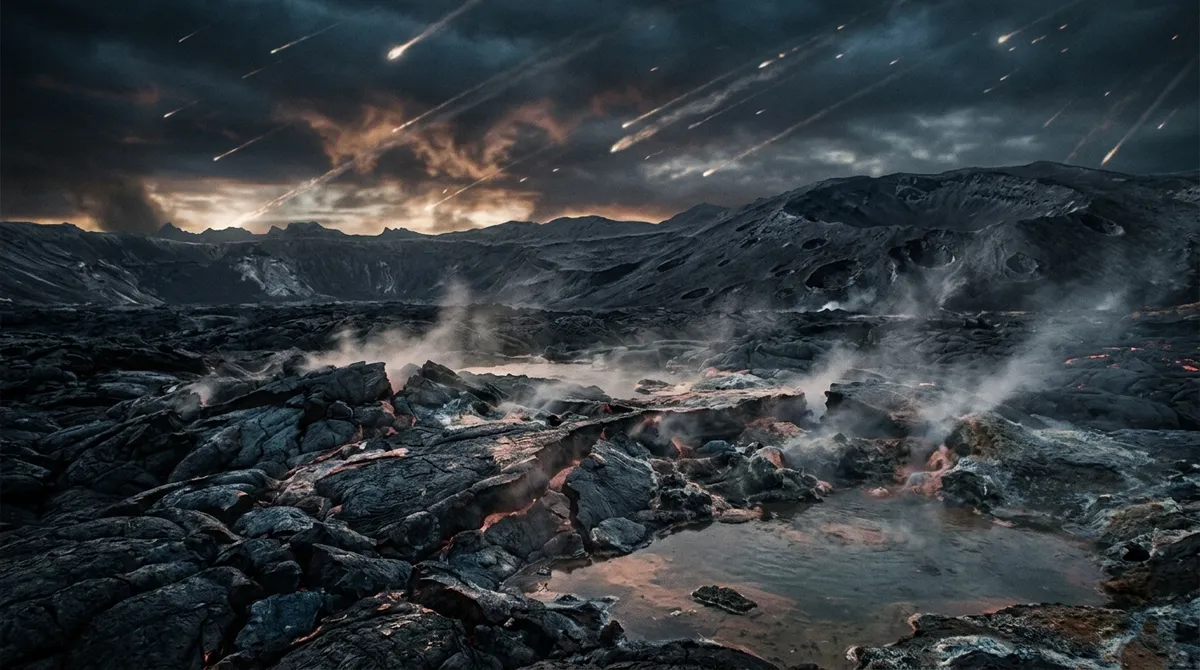
The story of life's origins on Earth just got a dramatic rewrite. According to new research, the relentless asteroid bombardment that pummeled our planet during its first billion years—previously thought to be a hostile force preventing life from emerging—may have actually created the perfect conditions for it.
Using sophisticated impact simulations, scientists have discovered that the cosmic bombardment occurring between 4.6 and 3.5 billion years ago did far more than simply crater Earth's surface. These impacts fractured the planet's crust and created highly permeable zones extending down to 8 kilometers deep, enabling fluid and gas circulation through solid rock in ways that would have been impossible otherwise.
The Paradox of Destructive Creation
This research fundamentally challenges our understanding of early Earth as a "hellish" environment incompatible with life's emergence. Rather than viewing the Hadean and Archean eons as periods of pure destruction, scientists are now recognizing how these seemingly catastrophic events opened crucial pathways for prebiotic chemistry.
The asteroid and planetesimal impacts that regularly bombarded Earth during this period created something extraordinary: impact-generated hydrothermal systems that provided the precise chemical conditions necessary for life to begin. These systems, born from cosmic violence, became the laboratories where the first complex organic molecules could form and interact.
Deep Earth Chemistry Labs
The permeable zones created by these impacts weren't just cracks in rock—they were dynamic chemical reactors. The circulation of fluids and gases through these fractured regions would have created environments rich in the energy gradients and chemical diversity that prebiotic processes require.
These ancient hydrothermal systems share important characteristics with modern environments where life thrives today, such as deep-sea hydrothermal vents and geothermal features like those found in Yellowstone. The connection suggests that the fundamental processes supporting life today may have their roots in these impact-generated systems from billions of years ago.
Reconstructing Ancient Worlds
Understanding these processes required sophisticated shock physics models to reconstruct planetary conditions from over 3.5 billion years ago. The challenge is immense—few rocks on Earth today are more than 4 billion years old, making direct evidence of these early processes extremely rare.
The simulations revealed how the energy from asteroid impacts could penetrate deep into Earth's crust, creating networks of fractures that remained active long after the initial impact. These weren't temporary disturbances but lasting geological features that could sustain chemical processes for extended periods.
Timeline of Terrestrial Transformation
The Hadean and Archean eons, spanning from Earth's formation 4.6 billion years ago to about 2.5 billion years ago, represent the most mysterious chapters in our planet's history. During the earlier Hadean eon (4.6-4.0 billion years ago), the bombardment was particularly intense, while the Archean (4.0-2.5 billion years ago) saw continued impacts alongside the first clear evidence of life.
This new understanding suggests that rather than life having to wait for the bombardment to end, it may have emerged precisely because of the unique conditions these impacts created.
Implications Beyond Earth
The research has profound implications for astrobiology and the search for life beyond Earth. If impact-generated hydrothermal systems were crucial for life's emergence on our planet, similar processes might be occurring on other worlds experiencing bombardment.
This framework could be particularly relevant for understanding the potential for life on exoplanets or icy moons in our solar system that have experienced similar bombardment histories. The violent early histories of celestial bodies, rather than being barriers to life, might actually be prerequisites for it.
A New Chapter in Origin Stories
This research represents more than just a refinement of scientific understanding—it's a fundamental shift in how we view the relationship between cosmic destruction and biological creation. The very forces that made early Earth appear uninhabitable may have been the key to making it the vibrant, life-supporting world we know today.
As scientists continue to unravel the complex chemistry of life's origins, this work reminds us that the universe's most creative processes often emerge from what initially appears to be pure chaos. The bombardment that scarred early Earth's surface simultaneously opened the pathways through which life would eventually flourish.