A Decade-Old Climate Puzzle Finally Solved
A decade ago, Bradley Markle, an assistant professor at the Institute of Arctic and Alpine Research at the University of Colorado Boulder, noticed something peculiar while examining temperature records from across Antarctica. The patterns he observed would eventually challenge fundamental assumptions about how Earth's coldest continent responds to climate change.
According to new research, Antarctica's regional temperature changes are governed more by the nonlinear greenhouse effect than by the traditional Planck response that climate scientists had long relied upon. This discovery suggests that warmer Antarctic regions may be far more sensitive to temperature fluctuations than previously understood.
The Greenhouse Effect's Hidden Power
The breakthrough centers on how water vapor amplifies greenhouse gas trapping as temperatures rise. Unlike the linear relationship scientists expected, this process creates a feedback loop that becomes more pronounced in warmer areas of the continent.
This nonlinear greenhouse effect explains why Antarctica doesn't warm evenly across its vast expanse. Instead of following predictable patterns based on solar radiation or atmospheric circulation alone, the continent's response to climate change appears to be governed by this amplifying mechanism that varies dramatically by region.
Warmer Antarctic regions appear to warm or cool more dramatically because of this water vapor amplification. As temperatures increase, the atmosphere can hold more moisture, which in turn traps more heat, creating an accelerating cycle that affects different parts of Antarctica to varying degrees.
Ancient Ice Cores Reveal Climate Secrets
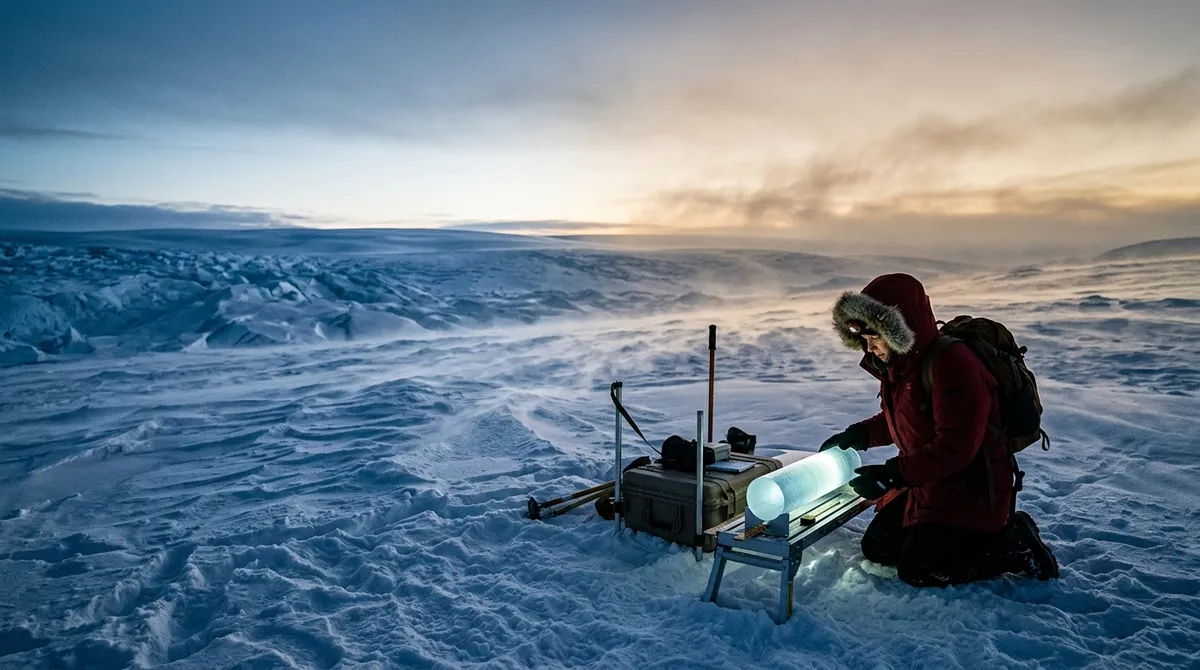
The research team turned to paleoclimate records, specifically ice cores spanning an impressive 160,000 years, to understand these processes. These frozen archives provided crucial evidence for how Antarctica's climate system has operated over geological timescales.
Ice cores serve as natural time capsules, preserving atmospheric conditions from millennia past. By analyzing these records, scientists could observe how the greenhouse effect has influenced Antarctic temperatures far beyond the scope of modern instrumental records.
The 160,000-year dataset revealed patterns that would have been impossible to detect using only contemporary climate data, highlighting why paleoclimate records are crucial for understanding processes playing out today.
Reshaping Climate Model Predictions
As climate models attempt to predict Antarctica's response to modern warming, this finding could fundamentally reshape assumptions about polar climate dynamics and ice sheet history. The discovery suggests that current models may underestimate the sensitivity of certain Antarctic regions to temperature changes.
The implications extend far beyond academic curiosity. Antarctica functions essentially as Earth's "heat exhaust valve," and understanding how it responds to warming has direct consequences for global sea level projections and climate system stability.
If warmer parts of Antarctica are indeed more sensitive to change than previously thought, this could accelerate ice sheet melting in those regions, potentially affecting global sea levels more rapidly than current projections suggest.
The Broader Climate Picture
This research represents more than just a regional climate study—it offers insights into how greenhouse gas effects operate in extreme environments. The nonlinear relationship between temperature and water vapor feedback demonstrates the complexity of Earth's climate system and the limitations of simple linear models.
The finding also underscores the importance of regional climate analysis. Rather than treating Antarctica as a uniform system, scientists must now account for dramatically different sensitivities across the continent based on baseline temperatures and local greenhouse gas dynamics.
Future Research Implications
The discovery opens new avenues for climate research, particularly in understanding how polar regions will respond to continued greenhouse gas emissions. Scientists can now better interpret both historical climate data and future projections by accounting for these nonlinear greenhouse effects.
This breakthrough also validates the critical importance of paleoclimate research. Without the 160,000-year ice core record, scientists might never have recognized these patterns or understood their significance for modern climate dynamics.
As researchers continue to refine climate models with this new understanding, the accuracy of Antarctic climate predictions—and their implications for global climate systems—should improve significantly. The decade-long mystery that began with Markle's observations has ultimately revealed fundamental truths about how our planet's climate system operates in its most extreme environments.