TL;DR
New research suggests that the asteroid bombardment Earth experienced over 4 to 3.5 billion years ago might have actually paved the way for life, rather than destroying it. These impacts fractured the crust, opening pathways for prebiotic chemistry essential for life.
Introduction: A Violent Yet Vital Era
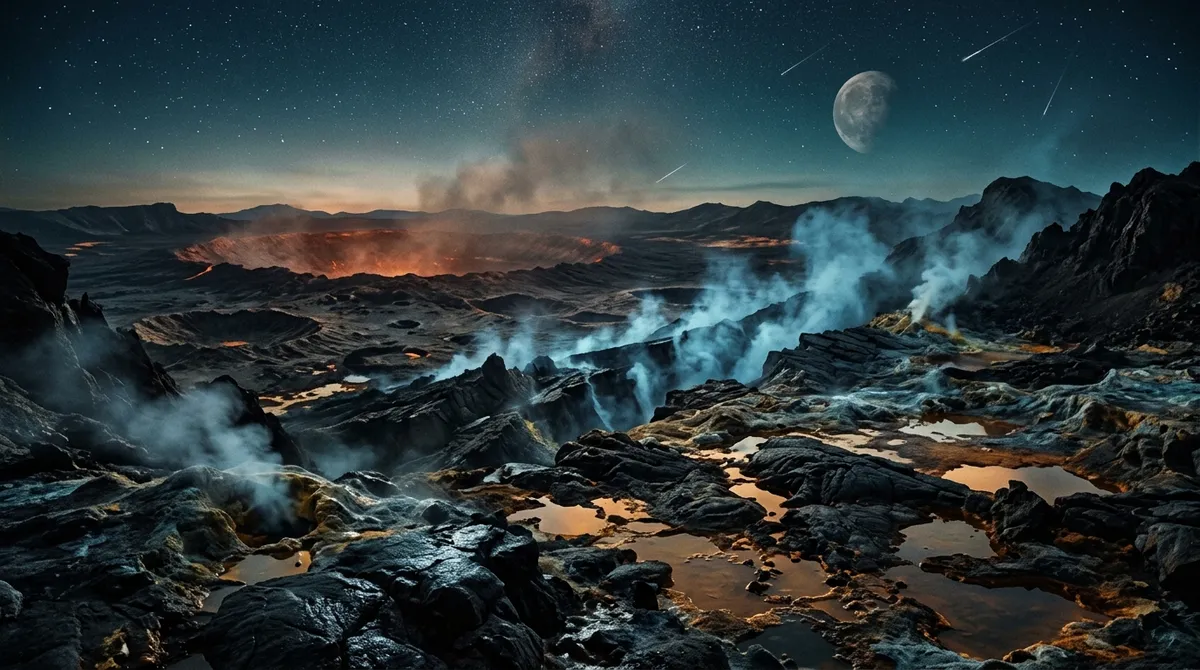
Imagine a planet in its infancy, bombarded by asteroids and inhospitable temperatures. Early Earth, for many, evokes images of a hellish landscape devoid of life. However, recent research reveals an intriguing paradox: the same cosmic chaos that seemed detrimental laid down the fundamental building blocks for future life. In this article, we’ll explore how these violent impacts fractured Earth’s crust, leading to the emergence of prebiotic chemistry. Buckle up as we journey back to a time that challenges our understanding of life’s origins!
The Hadean Eon: A Time of Chaos
Between approximately 4.6 billion and 4 billion years ago, Earth was undergoing what is known as the Hadean eon. Named after Hades, the Greek god of the underworld, this period was characterized by extreme conditions. Frequent asteroid and planetesimal impacts would lead to intense heat and a volatile atmosphere. But, rather than extinguishing all chances for life, these impacts played a crucial role.
Creating Permeable Zones
Recent simulations have revealed that these high-energy collisions fractured the Earth’s crust, creating highly permeable zones within the top 8 kilometers. You might wonder, how does cracking a planet's surface help foster life? Well, these fractures allowed for the circulation of fluids and gases through the rocks, leading to hydrothermal systems. These systems were likely hotbeds for chemical reactions essential to the emergence of prebiotic life.
Hydrothermal Vents: Nature’s Creators
If you think about modern-day analogues like deep-sea hydrothermal vents, the connection becomes clear. Just as these vents provide an energy source and chemical rich environment for unique life forms today, the early hydrothermal systems on primordial Earth could have created similar conditions.
How Life Might Have Begun
These systems may have facilitated crucial chemical reactions that formed the basis for life’s building blocks like amino acids and nucleotides. This means that rather than a barren wasteland, early Earth could be viewed as a rich chemical laboratory, teeming with potential. The striking narrative shifts from that of destruction to a somewhat nurturing cradle, opening the door for life to take its first breath.
The Archean Eon: Life Finds a Way
Fast forward to the Archean eon (4 billion to about 2.5 billion years ago), where the conditions brought forth by those cosmic impacts finally bore fruit. The first simple life forms began appearing, emerging from the very environment shaped by those ancient asteroid collisions. The transformation of our planet from a hostile world to a cradle for life offers insights into our own beginnings.
Simulation Science: Peering into Earth’s Past
How do scientists unravel these ancient mysteries? Researchers employ advanced shock physics models to simulate the impact conditions and analyze how they affect material changes within the Earth’s crust. By reconstructing these environments, scientists can better understand the processes that led to prebiotic life, providing a clearer picture of our planet’s formative years.
Astrobiological Implications: Searching Beyond Earth
Understanding how life began on our planet opens up exciting avenues in the quest for extraterrestrial life. If hydrothermal systems on early Earth contributed to life formation, similar environments on icy moons like Europa or Enceladus may hold the keys to finding life elsewhere in the universe. Researchers are now more focused than ever on how we might trace back the steps of life’s origins across our galaxy.
Conclusion: Embracing the Chaos of Origins
The narrative of early Earth as a hellish, uninhabitable place is gradually being replaced by a more nuanced understanding. The violent asteroid bombardments that we once considered obstacles to life turned out to be essential contributors to our existence today. As we continue to explore our past, we unveil not just stories of destruction but also of resilience and hope—a cosmic dance that brought forth the miracle of life.
In connecting the dots from ancient chaos to modern science, we not only satisfy our human curiosity but also lay the groundwork for future studies in space and the unknown—an exhilarating journey waiting to unfold!